
Fraud detection datasets must capture complex financial behaviors, evolving fraud patterns, and regulatory requirements. Annotating such data requires domain expertise, secure infrastructure, and rigorous quality control. This article explores the types of labeled financial data used to train fraud detection models, the expertise required to annotate them, and leading companies that provide financial AI training data.
The Data Types Fraud Detection Models Need
Fraud manifests in many forms, from unauthorized transactions and identity theft to coordinated money-laundering schemes. A fraud detection model requires multiple categories of labeled data, each capturing a different type of risk and helping it learn patterns from historical examples of both legitimate and fraudulent activity.
Transaction Data
Transaction data is the backbone of most fraud detection systems. It includes credit card purchases, bank transfers, wire transfers, payment amounts, timestamps, merchant categories, and device IDs. These records are typically labeled as fraudulent or legitimate transactions, along with chargeback status, fraud type, and transaction risk level. Models use these labels to learn the patterns that separate genuine activity from fraud.
Customer Identity (KYC) Data
Identity and KYC datasets help models verify customer identities and prevent identity-related fraud. Annotators label government ID images, biometric samples, and fields extracted from onboarding documents as authentic, forged, expired, tampered, or mismatched with customer information. These datasets train models to detect synthetic identities, document forgery, and onboarding fraud.
Customer Behavioral Data
Behavioral analytics capture sequences rather than single events. Labeled datasets – such as login history, device usage, mouse movements, typing patterns, session duration, and navigation behavior – help models distinguish normal user behavior from suspicious activity such as account takeover attempts, bot attacks, or credential stuffing.
Compliance and Communication Data
Fraudsters frequently exploit communication channels to target customers or financial institutions alike. Emails, chat logs, and call transcripts are labeled for suspicious language – phishing, scam, spam, social engineering – or marked as legitimate interaction. These datasets enable AI models to detect fraudulent communications before customers become victims.
Network and Relationship Data
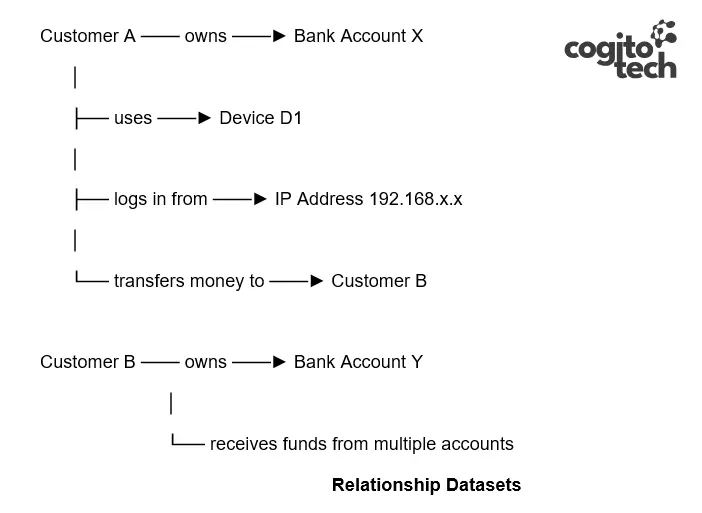
Modern fraud often involves coordinated networks rather than isolated individuals. Relationship datasets capture and label connections between customers, bank accounts, devices, IP addresses, merchants, beneficiaries, and transactions. These annotations enable graph-based AI models to detect coordinated fraud rings and money-laundering networks.
What It Takes to Label Financial Data
Financial data annotation is more than labeling records or objects in an image set. Annotators must be trained to understand financial products, fraud typologies, regulatory requirements, and evolving attack methods to ensure labels accurately represent real-world scenarios. Delivering high-quality financial datasets requires a combination of specialized expertise, secure infrastructure, and robust quality assurance processes.
Domain-trained Annotators: Analyzing structured transactions, layered transactions, or a forged identity document requires annotators with practical knowledge of financial products, fraud typologies, and regulatory definitions—not general-purpose reviewers.
Multi-layer Quality Assurance: A false negative in fraud detection can be very costly. This requires tiered review and calibration exercises to keep labels accurate, consistent, and reliable.
Secure, Compliant Infrastructure: Financial data frequently contains personally identifiable information (PII), so annotation environments need secure infrastructure aligned with SOC 2, ISO 27001, HIPAA (for financial-health-related data), and GDPR, along with strict access controls, encryption, and comprehensive audit trails.
Documented Data Provenance: Regulators increasingly require organizations to disclose data sources, labeling methods, and validation processes, in addition to model performance. This makes comprehensive documentation of dataset lineage just as important as the annotations themselves.
Top Companies for Fraud-Detection Financial Data Labeling
Here are leading companies that provide data labeling services for fintech and financial AI/ML teams.
Cogito Tech
Cogito Tech brings together financial analysts, banking specialists, AML investigators, insurance experts, and dedicated quality assurance teams to develop consistent annotation guidelines and validate edge cases. Its capabilities span transaction labeling, financial document annotation, document intelligence, multilingual data processing, and enterprise-grade quality assurance built for regulated industries.
CloudFactory
CloudFactory’s domain experts combine human oversight with AI-assisted automation to improve data quality, validation, and model reliability — from fraud detection to risk modeling — helping clients scale AI with accuracy, compliance, and trust.
TELUS Digital
TELUS Digital serves regulated industries, including banking, insurance, and fintech, where accuracy, compliance, and representative data are non-negotiable. Its Experts Engine connects vetted specialists and annotators with annotation and validation workflows, combining human insight, industry expertise, and modern digital platforms to deliver consistent, dependable data for financial AI applications.
Appen
Appen offers end-to-end data annotation and labeling services spanning documents, images, videos, audio, and text, making it suitable for diverse financial data types like contracts, invoices, and KYC records. It serves regulated sectors through its AI Data Platform (ADAP), which pairs global contributors with AI-assisted tooling and structured human-in-the-loop oversight.
Anolytics
Anolytics is one of the leading data annotation and labeling companies specializing in NLP and generative AI training data. It supports fraud detection through SME-led, human-in-the-loop annotation of financial data, backed by multi-stage quality audits and compliance with SOC 2 Type 1, GDPR, CCPA, and evolving AI governance requirements.
Conclusion
Effective fraud detection starts with high-quality labeled data. From transaction records and KYC documents to behavioral, communication, and relationship data, each dataset helps AI models recognize different fraud patterns. Combined with domain-trained annotators, secure and compliant infrastructure, and rigorous quality assurance, these datasets enable financial institutions to build accurate, reliable, and scalable fraud detection systems that can keep pace with evolving financial threats.
The post Financial Data Annotation for Fraud Detection appeared first on Cogitotech.