
How we built a Digital Twin of an Organization, powered by Claude, from prototype to production.
The Challenge Our Client Came to Us With
Organizations invest millions in transformation initiatives like new systems, restructured teams, AI adoption, without a complete picture of how they actually operate today. Process knowledge lives in documents that go stale, spreadsheets that contradict each other, and, most critically, in the heads of the people who do the work every day. There’s no single connected data set that ties processes, systems, roles, risks, and performance together.
That was the gap Insight Twin set out to close. Founded by Michael Schank, with over two decades of enterprise transformation experience at organizations including Bank of America, Accenture, and EY, Insight Twin needed a technology partner to turn that vision into a working platform: one that could build a living digital twin of how an organization actually works, then layer AI on top to deliver actionable insights rather than generic recommendations.
That’s where Spritle came in.
What We Built Together
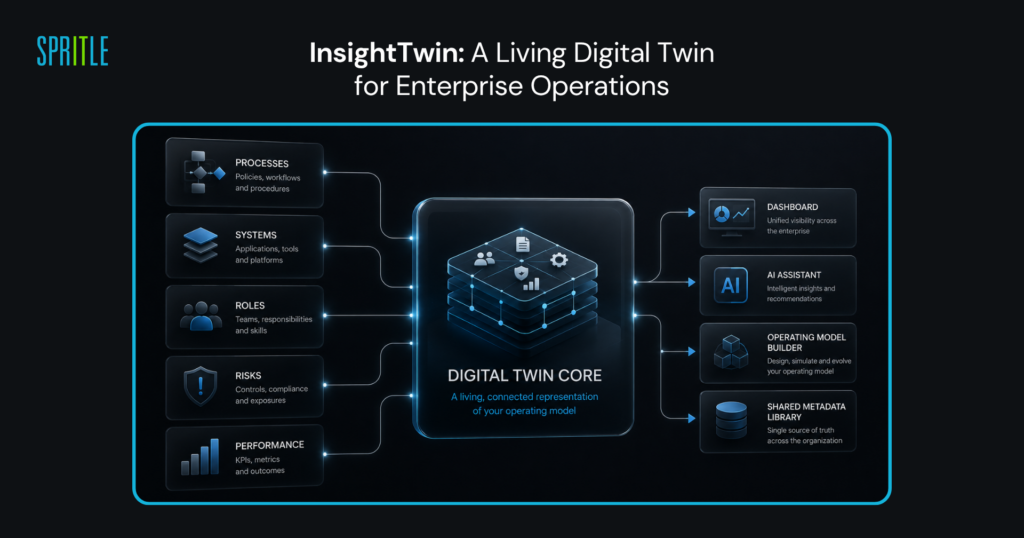
The InsightTwin platform is a Digital Twin of an Organization: a web application that ingests operational data from across a business (HR systems, technology repositories, risk databases, performance platforms) and combines it with institutional knowledge gathered directly from employees. The result is a connected model of everything the organization does: every process, every system, every role, every risk, linked together rather than siloed in separate tools.
With AI layered on top, the platform turns that model into real deliverables: transformation roadmaps, risk assessments, change-impact analyses, and project documentation that would otherwise take months of manual planning.
High-level view: a governed core connects source data to the modules users work with day to day.
Use Cases the Platform Enables
Because the digital twin connects processes, systems, roles, and risks in one model rather than in separate tools, it opens up use cases that would be impractical to tackle with disconnected data:
Transformation Planning: mapping current-state operations and generating AI-driven roadmaps for organizational change, so transformation leaders know exactly what they’re changing and what it touches before they start.
Risk & Compliance: linking each business process to the controls, risks, and regulatory requirements associated with it, and automating risk assessments that would otherwise require weeks of manual cross-referencing.
AI Readiness: identifying which processes are best suited for automation or AI augmentation, grounded in actual operational data rather than assumptions. As the founder puts it: organizations need to know every process, every system, every activity, and every person before AI can scale effectively.
Change-Impact Analysis: evaluating the downstream effects of replacing a system, restructuring a team, or retiring a process, across the entire operating model instead of guessing at one silo at a time.
To demonstrate these capabilities, the team built a reference model of a retail lending organization, mapping every process involved in loan origination and servicing alongside the systems, risk controls, and compliance requirements that support them.
How We Approached the Build
Phase 1: Proving the Core Experience
Rather than building every feature at once, we started with a focused MVP aimed at proving the core experience end to end: could administrators and modelers actually manage an operating model in one place, and would an AI assistant grounded in that data be genuinely useful rather than a generic chatbot bolted on the side?
That first release centered on four things working well together: a clear dashboard giving users an at-a-glance view of their organization’s data; an AI assistant that only answers from the organization’s own verified data, and says so plainly when information isn’t available yet, rather than guessing; an operating model builder where teams map out process inventories, value streams, and business capabilities as one connected structure; and a shared metadata library that keeps every process, risk, and system described consistently, everywhere it appears.
Phase 2: Scaling to Enterprise
With the MVP foundation validated, the next phase focused on making the platform enterprise-ready, not just feature-rich but properly governed.
Governed access replaced basic logins: role-based permissions across administrators, editors, approvers, and viewers, with single sign-on support and a lightweight email-based approval flow so approvers can sign off on content without needing a full account.
A structured promotion workflow replaced edit-in-place: content now moves through three stages (draft, review, and live) with automated validation, human QA review, and a full audit trail at every gate. Nothing reaches the production view without passing through those checks.
Content moves from draft to live through review gates, never edited in place.
Multi-tenancy was built into the data layer from the start: each organization’s data is fully isolated, with a central administration view for provisioning tenants, managing feature access, and tracking AI usage with configurable cost pass-through. The homepage was reworked into a personalized workspace, surfacing each user’s pending approvals, alerts, and mentions.
How Claude Powered This Build
Michael’s vision for InsightTwin included Claude as the AI engine powering the product’s built-in Assistant, a deliberate choice grounded in what Claude could do with structured organizational data. At Spritle, we’d already battle-tested Claude’s capabilities across earlier projects, so when the product itself needed Claude at its core, we saw the right moment to go further: applying the same tooling across the entire development workflow, not just the product feature. The 30% development time savings and the consistency gains that followed came directly from that decision.
Claude API, Michael’s choice for the product, powers the in-product AI Assistant, grounding every answer in the organization’s own verified data. When the data hasn’t been imported yet, the assistant says so instead of guessing. This was a deliberate design choice that matters when the answers feed into real business decisions about transformation, risk, and compliance.
Claude Code was embedded directly in our engineering workflow, from scaffolding new modules to reviewing and refactoring code, cutting the time between a design decision and working software.
Claude Team Enterprise, rolled out across the entire Spritle team working on this project, became part of our day-to-day workflow rather than a tool a few people used on the side. Across the build, that translated into roughly 30% less development time.
Claude Cowork let us turn design ideas into clickable prototype web pages, so every team member (developers, designers, and the client) could see and react to the exact same preview instead of interpreting a static mockup or a written spec differently.
Claude Code in our CI/CD pipeline (via GitHub Actions) reviews every pull request automatically, catching issues before a human reviewer opens the tab and keeping code review standards consistent regardless of who’s available that day.
Challenge
How Claude Helped
Result
Slow path from design idea to something the whole team could react to
Claude Cowork turned concepts into clickable prototype pages
One shared, exact preview for every team member, including the client
Engineering time spent on repetitive scaffolding and review cycles
Claude Code + Claude Team Enterprise embedded across the dev team
~30% reduction in overall development time
An AI assistant that needed to answer from real organizational data, not general knowledge
Claude API grounded the assistant in each organization’s verified source data
Answers users can trust enough to act on for transformation and risk decisions
Inconsistent PR review quality and slow reviewer turnaround
Claude Code running via GitHub Actions in our CI/CD pipeline
Every pull request reviewed automatically before a human opens it
Where Claude showed up across the build, from prototyping to production.
What Our Client Has to Say
“Spritle understood what we were building. A Digital Twin of an Organization has to describe how an organization actually operates, prescribe where it should go, act by producing tangible deliverables, and monitor performance against the model. Spritle took that methodology and made it working software, including an AI assistant that reasons over the connected model itself. They have handled that complexity, and we view them as a long-term partner.”
Michael Schank
Founder, Insight Twin
Learn more about InsightTwin at insighttwin.com.
The post How Spritle Built InsightTwin: A Living Digital Twin Platform for Enterprise Operating Models appeared first on Spritle software.