
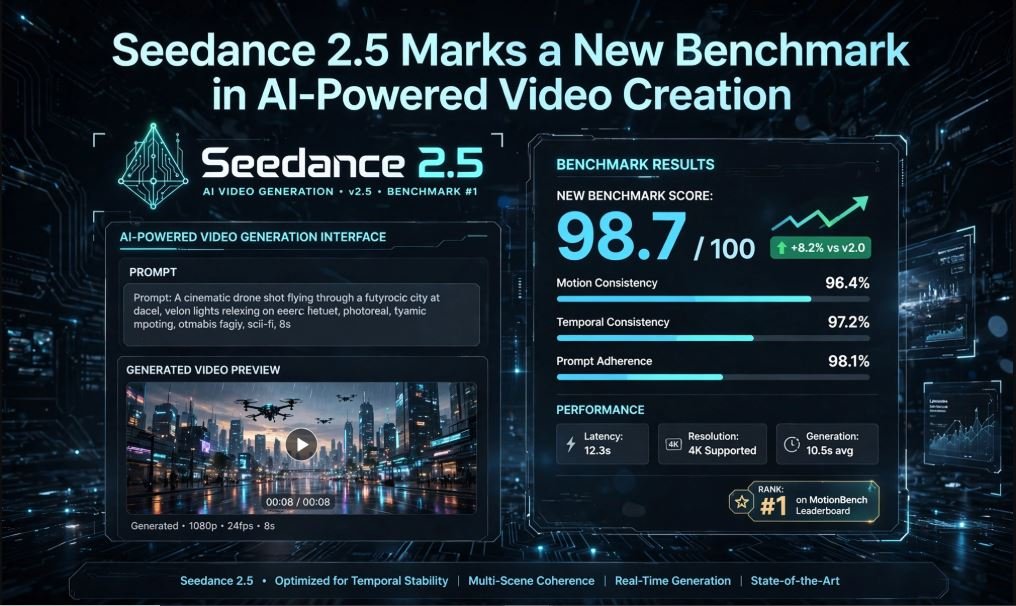
ByteDance’s generative video platform raises the bar for cinematic control, motion realism, and production-scale output — drawing attention from creators and studios alike
The landscape of AI video generation has shifted considerably in the past 18 months, but few tools have drawn as much industry attention as Seedance 2.5, ByteDance’s latest iteration of its generative video platform. Positioned at the intersection of creative flexibility and technical precision, the Seedance 2.5 AI video creation tool is quietly reshaping how independent filmmakers, brand studios, and enterprise content teams approach the production pipeline.
Where earlier generative video tools struggled with temporal consistency — the tendency for objects, faces, and lighting to shift unexpectedly between frames — Seedance 2.5 has introduced what ByteDance describes as a physics-aware motion architecture. In practice, reviewers and early adopters report that the model maintains subject coherence across longer sequences than competing systems, producing clips that hold up under close inspection in ways that previous AI video tools often didn’t.
What Sets Seedance 2.5 Apart
The Seedance 2.5 AI video creation tool ships with several capabilities that have become talking points among professional users. Foremost among these is its cinematic camera control system, which allows users to specify shot language — dolly-in, rack focus, aerial crane — through natural language prompts, without requiring manual keyframe work. This has particular appeal for pre-visualisation teams and solo creators who need broadcast-quality motion without a full production crew.
The model also demonstrates notably improved handling of text and typography within generated scenes — a persistent weak point across the generative video category. Seedance 2.5 renders legible signage, title cards, and in-scene text with accuracy that earlier tools frequently fumbled, opening the platform to use cases in advertising and branded content where visual accuracy is non-negotiable.
Alongside these technical improvements, the platform’s audio-video synchronisation layer has been substantially upgraded. The system can generate ambient sound, dialogue-adjacent audio, and scene-consistent music beds that respond to the visual content rather than operating as disconnected overlays.
Reception Among Creative Professionals
Early response from the professional creative community has been measured but genuinely interested. Several independent directors and digital agencies have shared publicly that Seedance 2.5 represents the first AI video tool they have considered integrating into a paid deliverable workflow, rather than treating purely as an experimental novelty.
The distinction matters. Much of the AI video generation category has remained confined to internal prototyping, social media experimentation, and creative exploration precisely because output quality has not been sufficiently reliable for client-facing work. The Seedance 2.5 AI video creation tool appears to be crossing that threshold for a meaningful segment of users, though industry observers note that the bar for professional deployment is high and varies considerably by sector.
The advertising and digital media industries — where fast turnaround and visual polish are both required — seem particularly attentive. Several mid-size production companies have begun piloting the tool for lower-tier deliverables, using it to accelerate rough cuts before handing off to human editors for finishing.
Competitive Context
Seedance 2.5 enters a market with genuine competition. OpenAI’s Sora, Google’s Veo 3, Runway’s Gen-4, and Kling — ByteDance’s own earlier model — all occupy overlapping territory. What Seedance 2.5 appears to offer that distinguishes it from some of these alternatives is a stronger emphasis on creative control and output consistency at longer durations.
Runway has historically led on editorial integration and professional workflow compatibility; Veo 3 has demonstrated strong performance on natural scene generation. Seedance 2.5’s differentiator appears to be the combination of camera control sophistication and motion physics — capabilities that matter most to users trying to produce intentional, directed content rather than atmospheric or ambient footage.
ByteDance’s access to one of the largest consumer video datasets in the world through TikTok’s ecosystem is widely cited as a factor in the model’s motion training quality, though the company has not disclosed specifics of its training pipeline.
Industry Implications
The arrival of the Seedance 2.5 AI video creation tool is part of a broader acceleration in generative media that is forcing creative industries to reckon with what kinds of production work remain distinctly human. The consensus among practitioners who have engaged seriously with the current generation of tools — Seedance 2.5 included — is that AI video generation is most accurately understood as a collaboration accelerant rather than a replacement for human creative direction.
The cinematographer’s eye, the editor’s pacing sense, the director’s intention — none of these translate through a text prompt alone. What tools like Seedance 2.5 can do is dramatically compress the distance between concept and watchable footage, making iteration faster and exploration cheaper.
For studios operating under compressed budgets and accelerating delivery timelines, that compression has real commercial value. Whether it represents a permanent shift in how video production is staffed and resourced — or a productivity layer that expands creative output without reducing headcount — is a question the industry is actively answering in real time.
Availability
Seedance 2.5 is currently accessible through ByteDance’s developer API and select enterprise partnerships, with a broader consumer-facing rollout reported to be in progress. Pricing details for enterprise tiers have not been publicly disclosed at time of publication.
The post Seedance 2.5 Marks a New Benchmark in AI-Powered Video Creation appeared first on Big Data Analytics News.